
Air Hunger.
That's it. Breathe.

Context & Content
Context: I wrote this approx two years ago, starting in February 2023 after my first Respiratory Physio appointment and across the next few months. This was eight months after I first got unwell and was written as a way to understand what I was going through. It was very difficult to write and remains difficult for me to read. It remains as is, uncensored as a record of a specific time. Proofread by my dad, who read it for the first time recently.
Content: This piece is about air hunger and explicitly talks about symptoms of and treatment for a severe Breathing Pattern Disorder. It describes in detail what this feels like and also covers and extrapolates connections with broader Long Covid symptoms and complex mental health recovery. It includes descriptions of panic attacks.
Please note: my understanding of my symptoms and treatment are my lived experience. I am not a medical professional.
[From Feb. 2023]
It’s a term I get given very matter-of-fact-ly. This is what it is. This is what is happening to you and in your body when you are breathless. Those big gulping breaths you take, like your life depends on it. Air hunger.
That’s it.
Air hunger.
It hangs in space like the title of a poem I will write one day. Two words holding everything.
It’s taken eight months to get here.
H– my physio is really nice. She has one of those no nonsense but clear and kind voices that people who help with rehab have. It’s encouraging and guiding and she explains things so clearly it nearly makes me cry. At the moment everything nearly makes me cry.
This exercise does. When I do it later on my own I can’t hold in the tears and I just weep.
I cry at how hard it is. At how bad I am at it. But there is also relief that I have been given something I can do – albeit not well (yet). I am learning how to breathe again.
A disrupted breathing pattern or breathing pattern disorder is quite common for people with post-Covid Syndrome or Long Covid. Essentially, due to dysregulation of the autonomic nervous system (dysautonomia) your breathing gets stuck in cycles where the body is still responding to infection. This continues and then develops into a habit where this becomes your new breathing pattern. So long after your body has actually ceased fighting the virus, you have disordered breathing.
For me this essentially means my breath is almost entirely in my chest. Other symptoms I have are an increased awareness of breathing, tightness in chest, bigger breaths more often (that’s the air hunger), more sighing and the main one: breathlessness. It’s literally as if there is no air; it’s a little like being puffed out of breath but you didn’t have the breath to start with. It’s not running out of breath because you never had it in the first place, and you can never quite get to the point of having it because it just isn’t there.
The idea behind having respiratory physiotherapy to relearn how to breathe is to retrain the body and brain into a healthier breathing patterns. To do this you have to isolate your lower diaphragm and take small breaths there whilst fighting against the rising panic in your chest and brain that you aren’t breathing.
It’s hard to describe the feeling that you can’t breathe, that you have no air, that you are holding your breath while you are actually breathing. Your chest is tight, your panic is rising and (gasp) the relief of that bigger breath that fills your chest feels life saving. Air hunger. It’s a bitch.
To choose to do this, and repeat it, for five minutes three times a day is quite the choice. Knowing what that decision meant, the context and having a way to describe the reaction is key I think to (literally) learning to breathe through it.
*
I’ve found through the intensive trauma recovery I have been in during the past few years that the most empowering thing I have gained is language. Language to express what was for so long unexplainable. There is a word or a phrase for this, a name for it. I am not ‘wrong’ or ‘broken’ there is a) a reason but also b) what I have experienced has a name, can be diagnosed and is treatable.
That’s not to underestimate how understanding and explaining something is confronting and traumatising in its own way - realising how actually bad my breathing is and being told that from a medical professional was terrifying. But knowing what it was, having it explained to me and having a term for the feeling and physical reality of what I was living? It completely revolutionised how I was able to relate to what I was experiencing.
For me this also ties in with the wider experience of living at the moment, not just doing the exercises but pretty much every time I do anything.
Any activity or exertion makes my breathlessness worse. Even writing this, propped up in bed, I have to stop and lie down. This main symptom is also closely tied in with tachycardia (increased heart rate) which I also experience, alongside fatigue and brain fog. My life has wound down to the barest essentials. And whilst I remain truly grateful for what I have, I’m not going to sit here and make you feel better while reading this by minimising how awful it is.
It's shit. And hard. And sometimes it feels impossible to even imagine recovery. Sometimes I feel I am starving for life. Hungry for the air outside, for the world, for people but mostly I am too tired.
At its worst air hunger is being stuck in a really scary cycle of breathing but not breathing while you are actually breathing but feeling like you’re not. It is micro-dosed panic attacks. And pushing through that, even in a supported way with understanding what it is, is hard.
For me, this is all further complicated by my mental health and my connection/disconnection with my body. In the first two weeks of doing this exercise it shifts a little. I still cry but not every time, and the full body panic has subsided to a lower level. But honestly anything that requires being ‘present’ in my body is hard work.
*
It’s now been five weeks and it’s better. The panic is no longer extreme, I do the exercise for longer breath cycles – but it depends, sometimes I am still gasping for air, my chest shuddering – sometimes I cry – sometimes I feel that there will be no end to this. Overall it feels better.
I take part in an online community project for people with Long Covid run by a big theatre company. There’s breathing exercises, which I can’t do and when I try I have a full on massive panic attack that I manage to ride out off camera. It's really scary and pulls me right back into the first two weeks of my physio work. When I’m processing it later I realise that while it was horrible and I need to mitigate this happening again it does really show that I have progressed. It reminds me that this is a beginning – it isn’t an end point. And I have started, I am moving in someway– even if it is just a small breath – in, out – one two.
In the following session they talk about trusting in breath and that also ties in with broader ongoing work of trusting myself, my body, everything – it’s foundational rebuilding of a different part of myself. It is after all relearning how to breathe.
I’m also learning to do things within what I can do. And I know now that I can do this exercise for five minutes, three times a day. So, I lie down– knees bent, feet flat and I place my right hand on my chest and my left hand below my ribs. And I count – in out, one two, in out, one two as I inflate a small balloon in my lower diaphragm.
That’s it.
It’s just the air hunger.
You aren’t dying.
Take the bigger breath, if you need.
And again.
*
After seven weeks I do still need to take that bigger breath. But I am someone who is realistic about time and recovery. It’s a practice and a process. I don’t feel like I am stopping as much. At my next appointment I will be moving onto the next stage of physio. Which feels scary to think about. But I remind myself that I am starting, I am going and I have both H–’s and my voice in my head talking me through it each time I do.
Breath in.
Breath out.
That’s it.
And again.
Breathe.
March 2025 has marked a lot of significant pandemic anniversaries and is also Long Covid Awareness Month. I’ve had a really difficult time, but two years ago it was even more difficult and it feels important to share. At the time of writing this piece I only shared it with my therapist.
I’ll write more about different stages of my recovery though nothing will be as ‘of the time’ as this especially I don’t think I can face reading my journals just yet. I’m going to finish with a photo - not from then, but from after my last session of respiratory physio in October 2023.
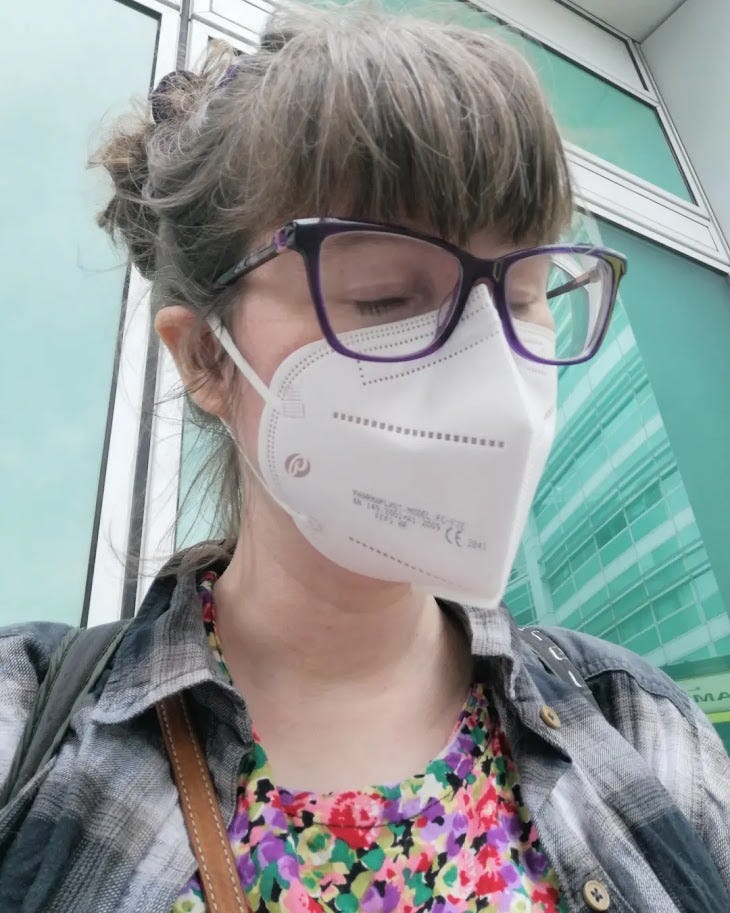
Thanks for meeting me where I am at.
(Currently beyond exhausted).
Tilly x
Thank you for explaining and taking us through your reality. As a longtime yoga student I have come to realise the centrality of breathing and how in everyday life we ‘forget’ to breathe. My twice weekly class and daily short practice keeps me in touch. Staying with and focusing on the breath is truly wonderous but it’s hard